
The question used to be simple: did you copy someone else's words? You either did or you didn't. Run it through a free plagiarism checker, see the score, move on.
In 2026, it's not that simple. Most writers I know draft with AI tools (including generative AI assistants) at least some of the time. They paraphrase heavily, remix ideas from five sources, and publish faster than ever. The risk isn't always deliberate copying. Sometimes it's unintentional plagiarism: accidental overlap, AI-generated passages that echo existing content, or similarity flags that don't mean what people think they mean. That's exactly why using a plagiarism checker has become a standard step in any serious writing workflow.
I tested ten free plagiarism checkers online using a real-world writing scenario: an AI-assisted draft with a bit of plagiarism. I evaluated each tool on detection accuracy, report quality, ease of use, and pricing — covering both free and paid options. And in this article, I'm going to tell you exactly which one to use based on your situation.
Quick Comparison: Top 10 Free Plagiarism Checkers at a Glance
|
Tool |
Best For |
Free Plan? |
Scan Limit |
Paid Pricing |
AI Detection? |
|
GPTinf |
Writers & AI users |
Yes (500w/scan) |
Unlimited (paid) |
$9–$29/mo |
Yes |
|
Turnitin |
Students (institutional) |
No (institution only) |
Institution only |
Institution only |
Yes |
|
Scribbr |
Academic writing |
No |
Pay per check |
$19.95–$39.95/scan |
No |
|
Grammarly |
Grammar + light check |
No |
Unlimited (Pro) |
$12–$30/mo |
No |
|
Copyleaks |
AI detection + academic |
Limited trial |
Unlimited (paid) |
From $13.99/mo |
Yes |
|
Quetext |
Students, general use |
Yes (limited) |
Unlimited (paid) |
From $8.80/mo |
No |
|
DupliChecker |
Casual / budget use |
Yes (limited) |
Paid tiers |
From $5/wk |
No |
|
Copyscape |
Web/blog content |
Pay-per-use |
Pay-per-use |
~$0.03/search |
No |
|
PrePostSEO |
Bulk content screening |
Yes (limited) |
Unlimited (paid) |
From $10/mo |
No |
|
Compilatio |
European institutions |
No |
Credit-based |
From €4.99/5k words |
No |
How I Tested These Plagiarism Checkers: Same Text, Seven Free Versions
To give this comparison real grounding, I ran the same AI-assisted text through every tool on this list that offers a free version or free account. The passage was a 320-word piece about social media and academic performance generated with AI, lightly edited, and containing paraphrased content drawn from several published research sources. It's exactly the kind of writing that most content creators and students actually need to check for plagiarism issues before publishing or submitting.
Three tools on this list — Turnitin, Scribbr, and Compilatio — don't offer individual or free access, so I couldn't include them here. The results below cover every tool that let me run a scan without a paid subscription.
| Tool | Similarity Score | Sources Found | Key Observation |
| GPTinf | 100% plagiarism | 152 sources | Most comprehensive: sentence-level attribution, largest source database, full report on free account |
| Grammarly | "Significant plagiarism" | Not shown (locked) | Detected plagiarism but hides all details behind Pro paywall; least informative free experience |
| Copyleaks | 79.4% matched text | 14 results | Also flagged 100% AI Content — the only free tool to surface both dimensions simultaneously |
| Quetext | 53% | 9 matches / 7 sources | Most detailed free-tier report; color-coded inline highlighting; caught paraphrased content well |
| DupliChecker | 7% plagiarism | 1 source | Dramatically under-detected; only flagged one source; missed all others |
| Copyscape | No % score | 4 results | Lists source pages only; no consolidated report on free tier; requires Compare Text per source |
| PrePostSEO | 25% plagiarism | 2 matches | Clean donut chart; source-linked highlights; caught main paraphrased sentences |
Why the scores vary so dramatically: The same 325-word text returned plagiarism percentages ranging from 7% (DupliChecker) to 100% (GPTinf). This isn't a contradiction — it reflects different database sizes, different matching algorithms, and different thresholds for what counts as a match. Scores across tools are not comparable. When choosing a tool, the question isn't "which score is right" but "which tool surfaces the most useful information."
What the Test Revealed About Each Tool
GPTinf returned the most comprehensive results by a wide margin: 100% plagiarism score, 152 sources identified, and a sentence-level breakdown showing exactly which sources matched each part of the text — with pmc.ncbi.nlm.nih.gov at 42% match across 12 segments and researchgate.net at 35% across 10. The detail level on the free account is what paid plans on other tools often don't reach.
Grammarly flagged "significant plagiarism" but showed nothing actionable. No percentage, no source links, no highlighted sentences — just a gate to upgrade. As a free plagiarism checker, the experience is almost worthless. If you're already on Grammarly Pro, it becomes usable; without it, you're paying for a notification, not a report. Grammarly offers writing and editing support as its core strength, and the plagiarism feature reflects that hierarchy.
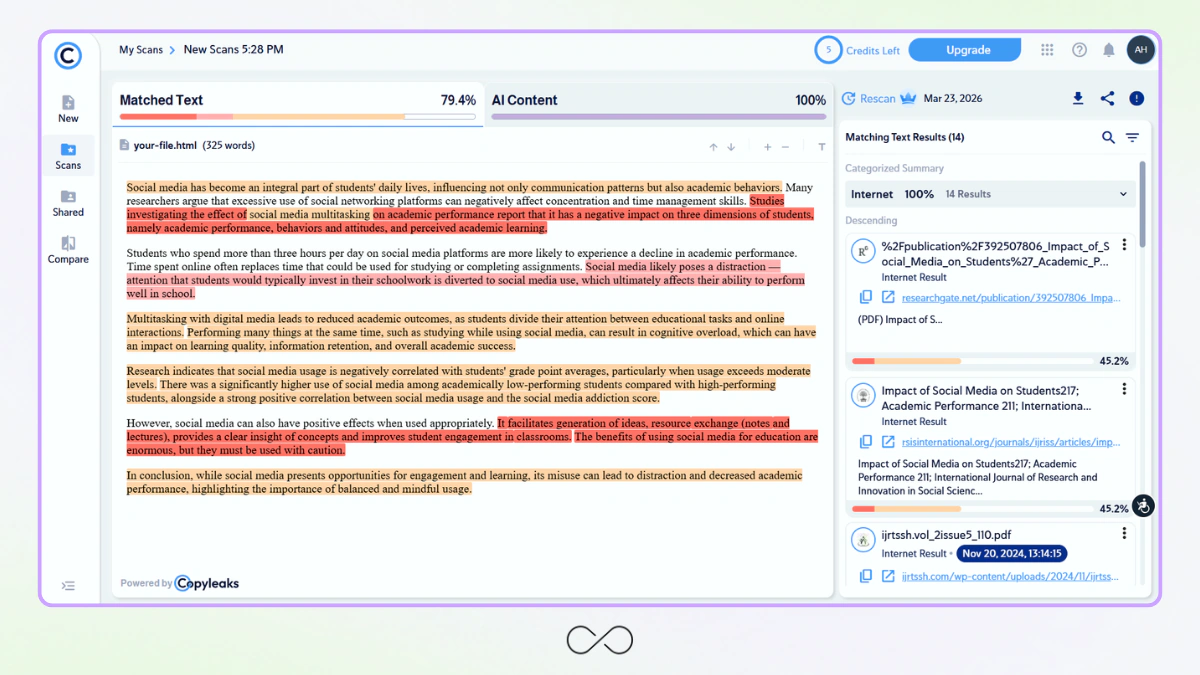
Copyleaks was the standout result for dual-layer detection. It flagged 79.4% matched text and — critically — independently identified 100% AI Content in the same scan. No other tool in this test surfaced both dimensions on its free version. The interface is more complex than simpler tools, but the depth is real.
Quetext was the best-performing free-tier tool outside GPTinf and Copyleaks. It returned 53% similarity across 9 matches from 7 sources, with color-coded inline highlights that made it easy to see exactly which sentences were flagged. For a free plagiarism detector without AI detection, this is genuinely useful output.
DupliChecker was the most dramatic under-detector in the test, returning just 7% against a passage that other tools flagged at 25–79%. It caught one source and missed everything else. Its exact-match breakdown (7% exact, 0% partial) tells the story: it's only catching near-verbatim content. Don't use it if you need to catch plagiarism at the paraphrasing level.
Copyscape gave no similarity percentage at all — just a list of four URLs with matching snippets. On the free version, you have to click "Compare Text" on each result individually to see what overlaps. This is a meaningful limitation for anything beyond identifying whether a specific web page was scraped. It's purpose-built for web duplication and not designed for academic use.
PrePostSEO returned a 25% score with 2 source matches and presented the results clearly — a donut chart, source links, and highlights passages that require citations flagged in the body. For a free online plagiarism checker, the report layout is genuinely readable. It missed several paraphrased sources that more capable tools caught, but it's a reasonable quick check.
The Best Free Plagiarism Checkers Online: Full Reviews
1. GPTinf — Best Free Plagiarism Checker for Writers Working with AI
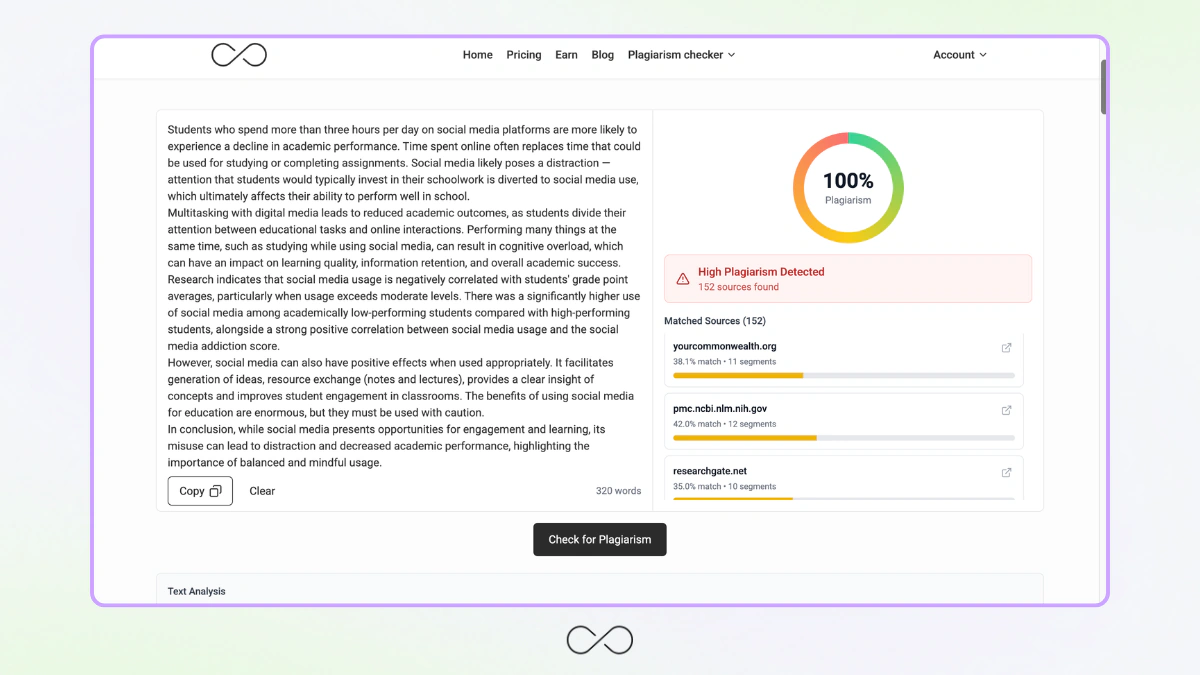
If you use AI tools in your writing (even occasionally), GPTinf is the only option on this list designed to address that reality directly. Most popular plagiarism checkers were built for students worried about copying from a textbook. GPTinf was built for the modern writer: someone who drafts with ChatGPT, edits in Notion, publishes to WordPress, and needs to know that what goes out is genuinely original. It uses advanced AI to check your writing against a database spanning billions of web pages and published research sources.
The free account is available after a quick registration — about a minute, no credit card required. You get 500 words per scan as part of your free attempts, which is enough to check individual sections of a longer piece or entire short-form posts. For checking a full article in chunks, it works well.
Where GPTinf separates itself from plagiarism checkers like Turnitin or Scribbr is the paid plan and its bundled feature set. Upgrade to any paid tier and you get unlimited plagiarism checks with no cap on words per month, plus full access to the humanizer tool. The humanizer takes AI-drafted text and refines it so the language flows more naturally — there's a meaningful difference between improving the quality of AI-assisted writing and deliberately deceiving someone, and GPTinf is built for the former.
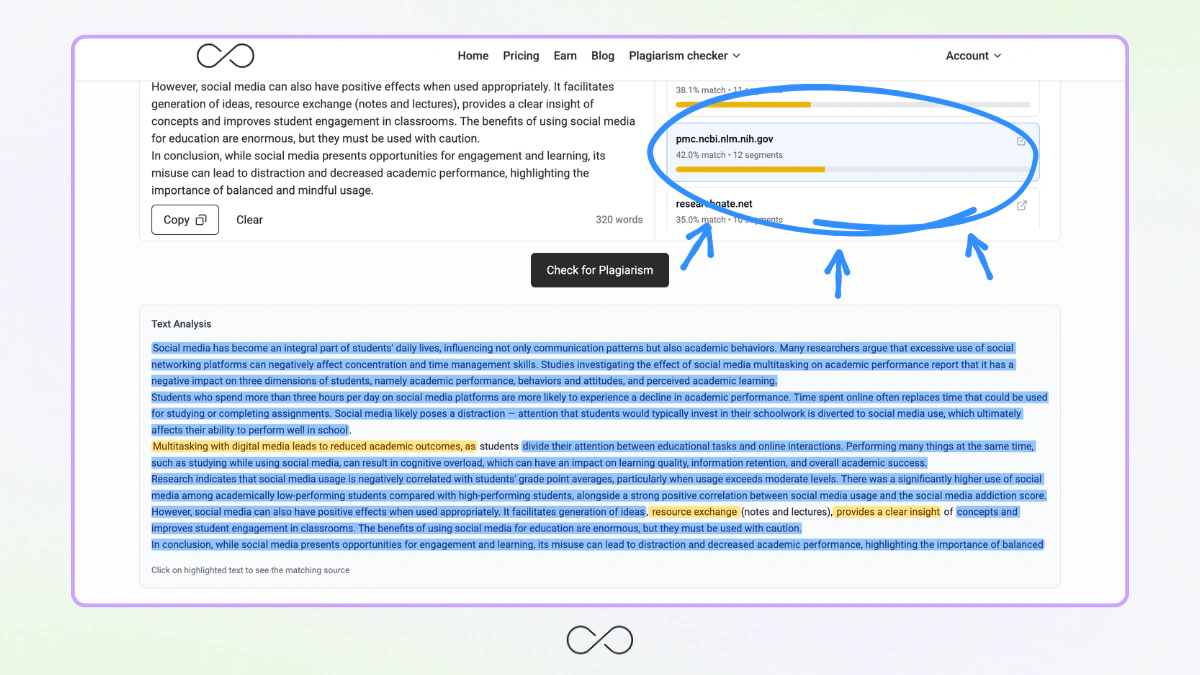
In hands-on testing, GPTinf returned the most comprehensive results of any tool tested: 100% plagiarism detected, 152 sources identified, and a sentence-level breakdown showing exactly which sentences matched which sources. This level of granularity in the detailed reports (on the free version) is what other tools charge for.
The honest cons: the 500-word free limit means a 3,000-word article requires multiple scans on the free account, and the tool is less oriented toward academic journal and institutional database coverage than Scribbr or Turnitin.
| Pros | Cons |
| Free 500-word scan tier with no credit card | Free tier requires registration (minor friction, but worth noting) |
| Unlimited checks and no words-per-month cap on paid plans | 500-word free limit means chunking longer documents |
| Detailed reports with sentence-level source attribution (most granular of any tool tested) | Less suited to deep academic database coverage than Scribbr or Turnitin |
| Bundled humanizer tool included in paid plans — addresses plagiarism and AI writing quality in one platform |
Pricing: Free account available (500w/scan). Paid plans start around $9/month.
Best for: Writers, bloggers, freelancers, content teams, and anyone who uses AI tools in their workflow.
2. Turnitin — The Academic Standard (That Most People Can't Access)
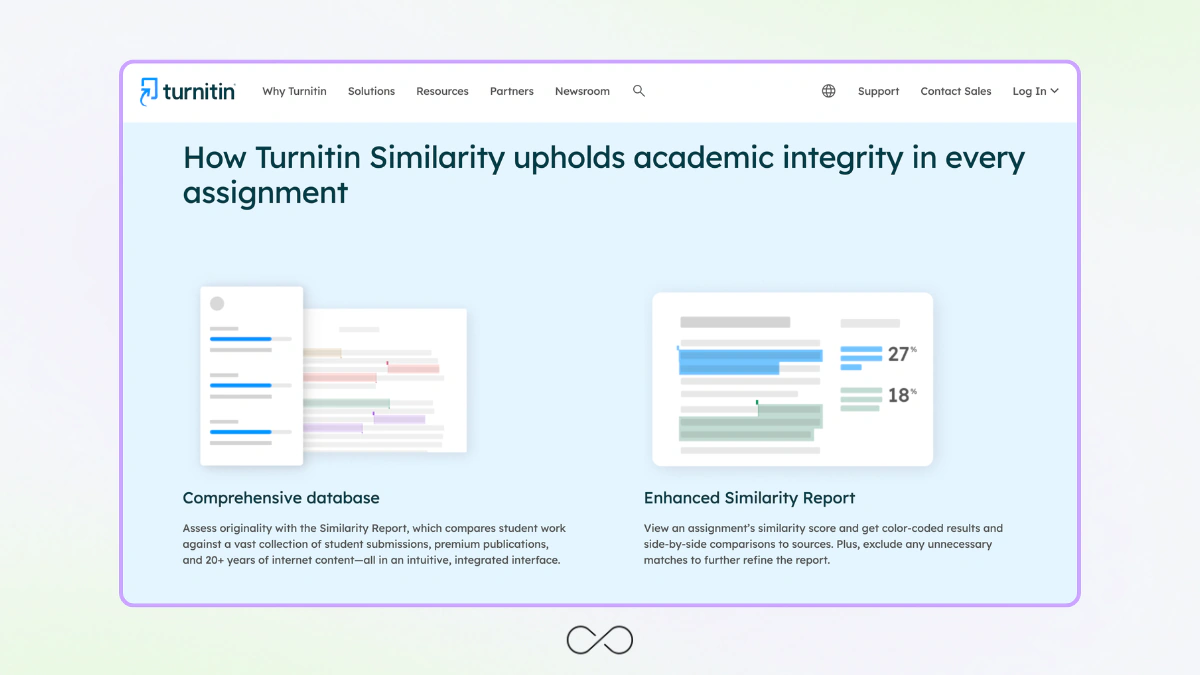
Turnitin is the most trusted name in maintaining academic integrity. It has over 1.8 billion student paper submissions in its database, partnerships with more than 20,000 institutions globally, and a track record that makes it the default for universities, colleges, and high schools worldwide.
The catch is that Turnitin is not available to individuals. You cannot sign up for a free account as a student, a freelancer, or a curious writer. It is exclusively institution-facing. If your school doesn't subscribe, Turnitin is simply not an option for you and there is no free version.
The best proxy for Turnitin's results is Scribbr, which uses iThenticate technology, the same engine Turnitin uses for research-grade work. No free-tier test was possible for this tool. Results are based on institutional documentation and third-party methodology reviews.
| Pros | Cons |
| Largest academic paper database in the world | Not accessible to individuals — institution-only |
| Industry standard in academic institutions globally | Cannot be self-subscribed, no free tier, no public pricing |
| Catches paraphrasing and structural similarity, not just verbatim copying |
Best for: Students at institutions that use it. Everyone else needs an alternative from this list.
3. Scribbr — Most Accurate for Academic Writing
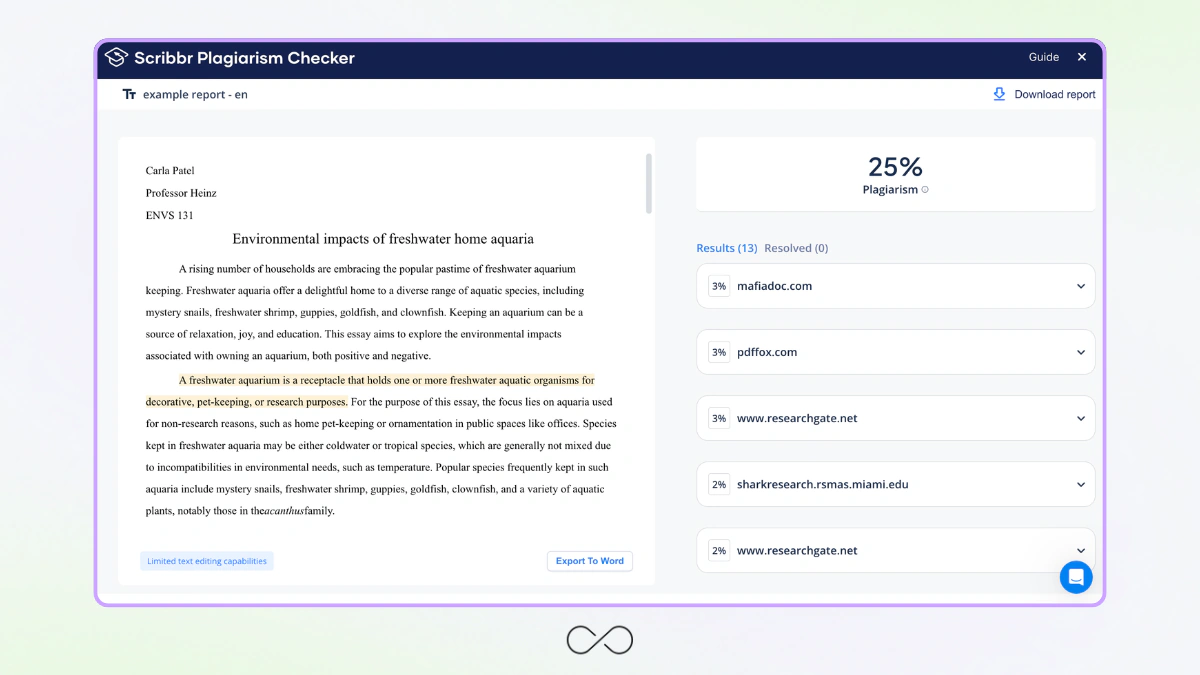
Skribbr's sample report
Scribbr doesn't make noise, it just delivers accurate results. In independent testing across 12 tools, it came out at 4.7 out of 5 for detection accuracy (the highest of the group). It uses iThenticate technology, which is the same database infrastructure that underlies Turnitin's research-tier product, covering academic journals, published research, and billions of web pages. For high-stakes submissions like a dissertation or thesis, Scribbr is the closest thing to Turnitin that you can actually pay for as an individual.
Where it shines is in catching forms of plagiarism beyond verbatim copying. Scribbr catches the sneakier overlap: passages that have been reworded but still borrow too heavily from a source, the kind of thing that matters most when maintaining academic integrity on high-stakes work.
The trade-off is the pricing model. There's no free version and no free account: you pay per check, between $19.95 and $39.95 depending on word count. For a one-off high-stakes submission, that's reasonable. For a content creator checking five posts a week, it's not the right tool. No free-tier test was possible, so results are based on independent accuracy benchmarks and iThenticate documentation.
| Pros | Cons |
| Highest independent accuracy score of any consumer tool tested | No free version or free account (pay-per-check model only) |
| iThenticate database (same as Turnitin's research tier) |
Expensive for frequent use |
| Excellent at catching forms of plagiarism including paraphrased content | No AI detection layer |
| Detailed reports with source-level breakdowns |
Pricing: $19.95–$39.95 per check.
Best for: Students submitting dissertations, theses, or other high-stakes academic work who want the most accurate results available.
4. Grammarly's Plagiarism Checker: Convenient, But Thin
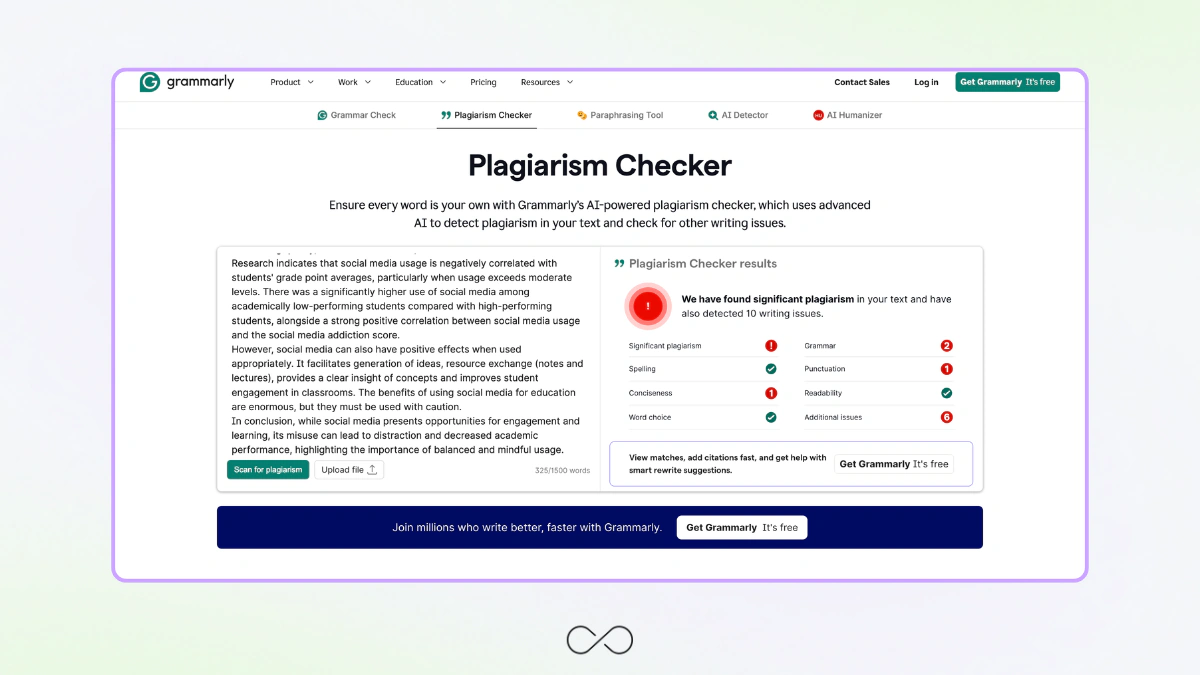
Grammarly is, first and foremost, a writing and grammar tool. The plagiarism checker exists as a feature inside the Pro plan, which costs around $30/month (or ~$12/month on an annual plan). If you're already paying for Grammarly Pro, the plagiarism check is there and it takes no extra effort. That convenience has real value.
The results, though, require tempered expectations. In hands-on testing, Grammarly's plagiarism checker fired on the test passage but locked every actionable detail behind an upgrade prompt on the free version. No plagiarism percentage, no source links, no highlights, just a notification. For writers already on Pro, independent testing puts detection accuracy around 40%, meaning it misses roughly six in ten instances of paraphrased borrowing. For anything where you need accurate results, that's not enough.
Grammarly offers genuinely strong writing and editing features: grammar, clarity, tone. The plagiarism checker exists as a supporting feature, not a headline one, and the tool reflects that priority.
| Pros | Cons |
| Integrated into an already-useful writing tool | Free version hides all report details (least informative free experience of any tool tested) |
| Works within Google Docs via browser extension | ~40% detection rate (misses significant paraphrased content) |
| No extra login for existing Pro users | Same highlight color for all sources makes reports hard to scan |
| No AI detection | |
| Requires Pro plan for accurate results |
Pricing: $12/month (annual) or $30/month.
Best for: Writers already on Grammarly Pro who want a quick sanity-check alongside writing and editing support. Not for serious plagiarism verification.
5. Copyleaks — Strongest AI Plagiarism Checker in a Standalone Tool
Copyleaks is one of the few online plagiarism checkers designed from the ground up to handle both traditional plagiarism detection and AI content detection as co-equal priorities. Most detection tools added AI detection as an afterthought; Copyleaks built it in from the start. It uses advanced AI to scan text for plagiarism issues and machine-generated patterns simultaneously.
In testing, Copyleaks returned 79.4% matched text and (in the same scan) flagged 100% AI Content. No other tool in this comparison surfaced both dimensions on a free version. The report listed 14 matching results with inline highlighting, drawing on a database that spans billions of web pages and academic sources. For someone who needs Turnitin-level coverage without institutional access and also wants AI detection, Copyleaks is the strongest combination available.
| Pros | Cons |
| Built-in AI detection — one of the most capable in this class | Interface can feel complex for casual use |
| Broad document type support including code | Reports take longer to parse than simpler tools |
| Detailed reports with 14 results in testing. | Limited free attempts before upgrade is required |
Pricing: From $13.99/month.
Best for: Writers and academics who need both plagiarism detection and AI detection in one online plagiarism checker.
6. Quetext — A Solid Free Option with Limits
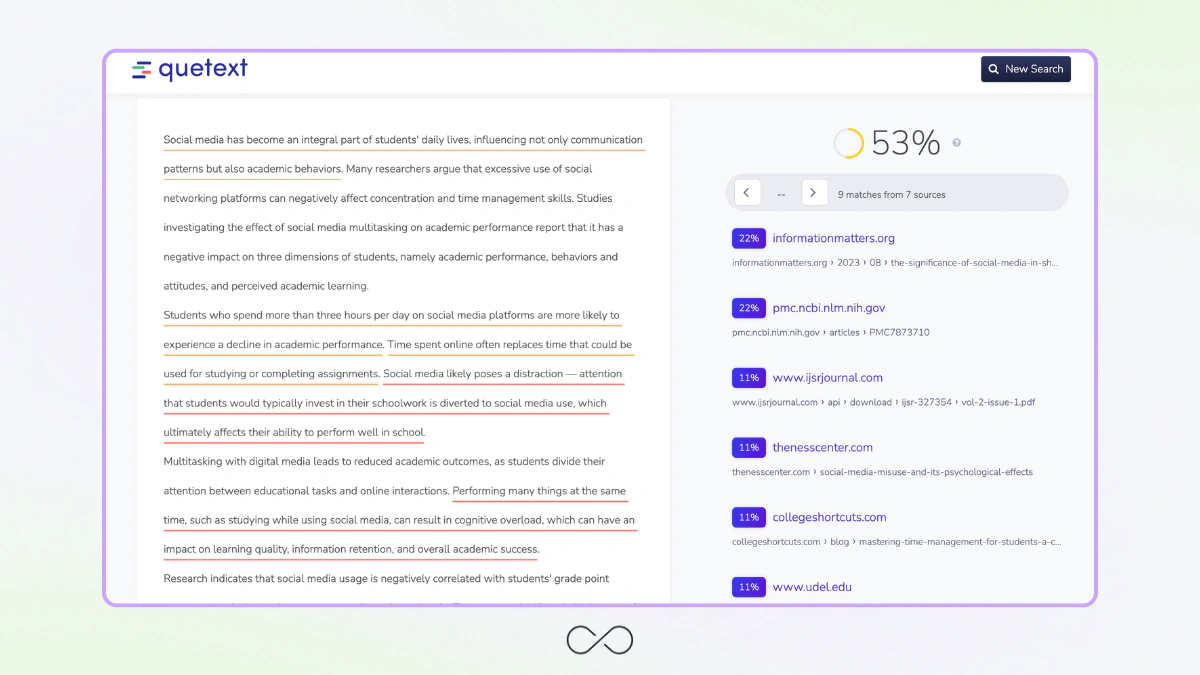
Quetext is one of the more capable free plagiarism checkers for students doing occasional work. It returned 53% similarity across 9 matches from 7 sources in testing, the most detailed free-tier report of the simpler tools, with color-coded inline highlights that clearly show which sentences are flagged. It calculates an overall originality score and breaks it down by source, which gives you a real picture of where the plagiarism issues are concentrated.
It starts to fall apart on heavily paraphrased content, but for light use or short documents it does the job. Paid plans start at $8.80/month, with higher word-per-month limits and unlimited scans available on premium tiers.
| Pros | Cons |
| Best free plagiarism checker for students needing solid free attempts | Struggles with paraphrased content (detection tools may miss heavily reworded material) |
| 53% detection in testing with color-coded inline highlights | Reports harder to navigate on longer documents |
| Calculates an overall originality score with source-level breakdown | No AI detection |
| 7 sources identified in free-tier test | |
| Affordable paid plans |
Pricing: Free tier available. Paid from $8.80/month.
Best for: Students or writers doing infrequent checks on shorter content and not worried about paraphrasing detection.
7. DupliChecker — Budget-Friendly, Basic
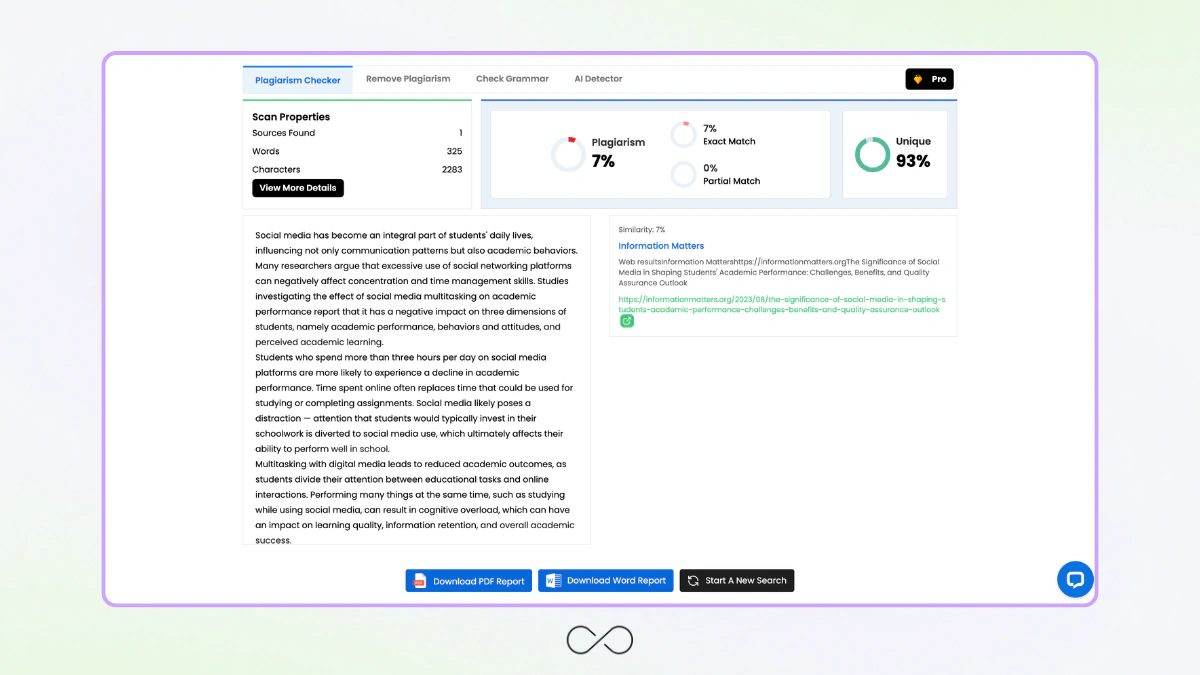
DupliChecker is the bottom-shelf option, and I mean that without being dismissive. Sometimes you just need to know whether a freelancer handed you something copied from an online plagiarism source, and DupliChecker covers that narrow ground.
In testing, DupliChecker was the most dramatic under-detector of all the plagiarism checkers online: just 7% against a passage that every other tool flagged at 25% or higher. The exact-match breakdown (7% exact, 0% partial) confirms the picture. Among popular plagiarism checkers, it has the smallest detection footprint. It catches near-verbatim copies and misses almost everything else. Don't use it for anything where accurate results actually matter.
| Pros | Cons |
| Very affordable (starts at ~$5/week) | Only 7% detected in testing (lowest of all plagiarism checkers tested) |
| Clean, easy interface | Detection tools may miss most forms of plagiarism beyond verbatim copying |
| Scan history maintained | Not suitable for maintaining academic integrity |
| No AI detection |
Pricing: From $5/week.
Best for: Very casual checks where cost is the primary consideration and accuracy stakes are low.
8. Copyscape — The Benchmark for Web Content
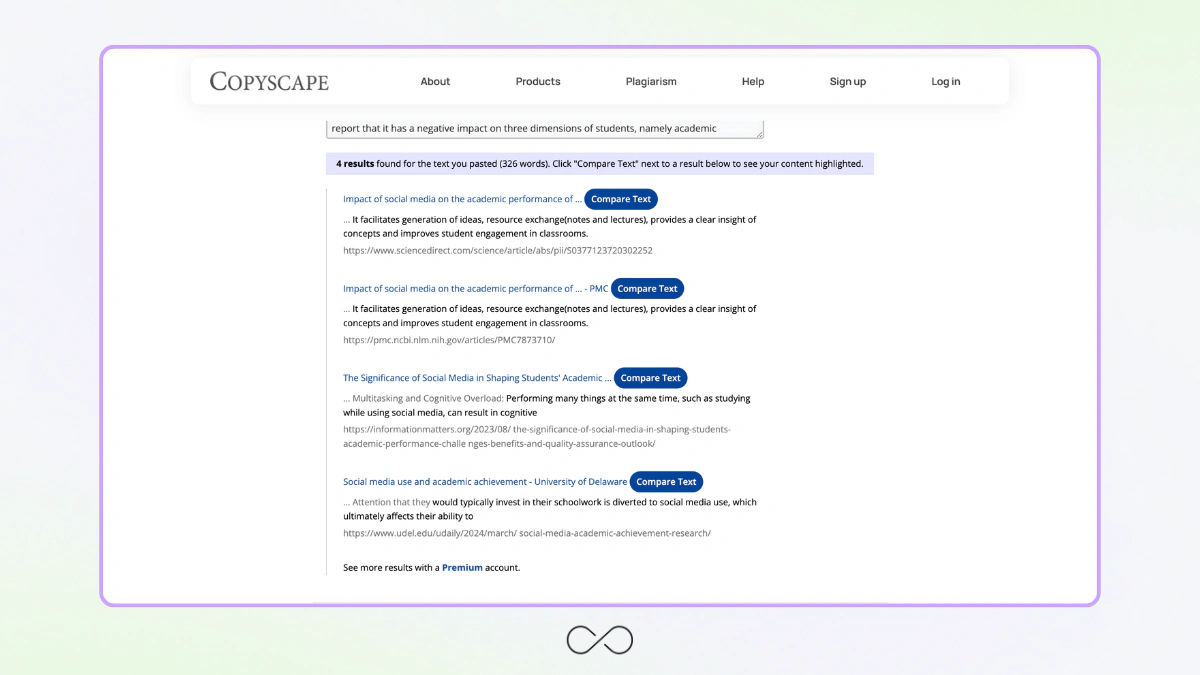
Copyscape does one thing well: it detects duplicate content across billions of web pages. If you publish blog posts and want to know whether a competitor has scraped your content, or whether your outsourced writer handed you something lifted from another site, Copyscape is the right online plagiarism checker for that job. It is not for maintaining academic integrity. It is not an AI plagiarism checker. It is specifically and usefully for web content originality.
In testing, Copyscape identified 4 matching sources but returned no plagiarism percentage, just a list of URLs with snippets. On the free version, you click "Compare Text" per source individually rather than reading a consolidated report. The pay-as-you-go model (~$0.03 per search) means no monthly commitment.
| Pros | Cons |
| Best-in-class for detecting online plagiarism across web-indexed content | No plagiarism percentage on free version (just source links) |
| Pay-as-you-go — no monthly commitment | Not designed for academic journals or published research |
| Straightforward, purpose-built interface | Limited to web-indexed content |
| No AI detection |
Pricing: Pay-as-you-go, ~$0.03 per search.
Best for: Bloggers, SEO writers, and content publishers checking for web-based duplication.
9. PrePostSEO — High Volume at Low Cost
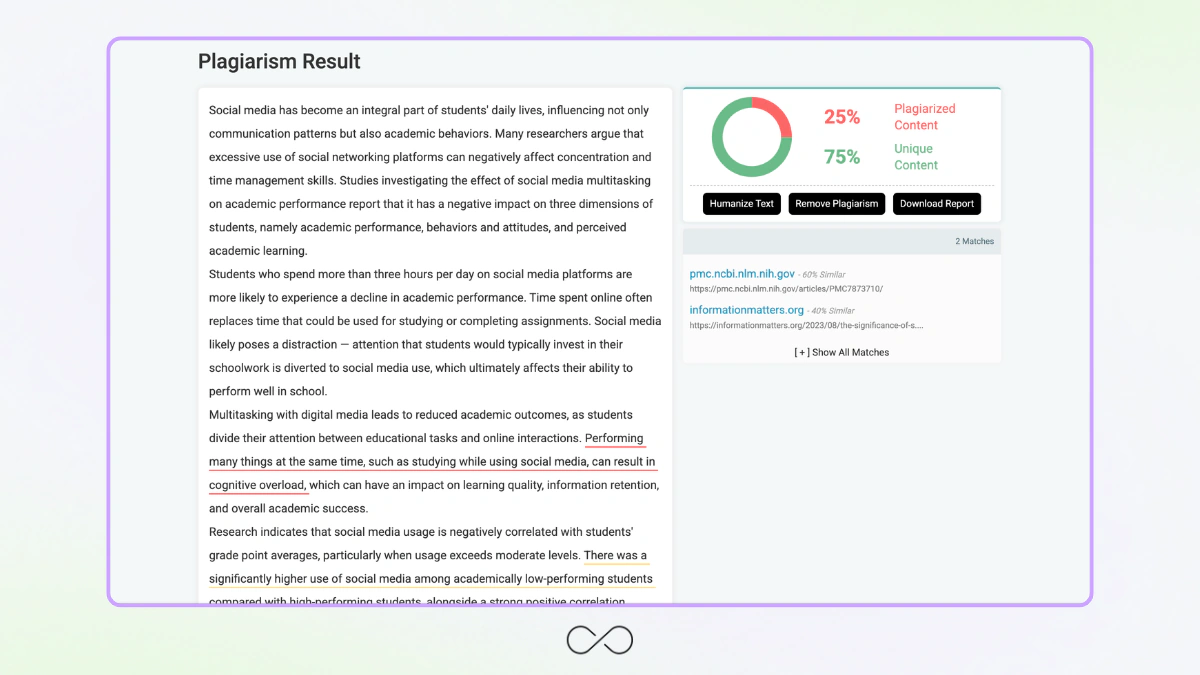
PrePostSEO handles volume well — $10/month for 5,000 sentence checks gives you a low cost per unit of content scanned. In testing, it returned 25% with 2 matched sources and presented results cleanly: a donut chart, source links, and highlights passages that require citations directly in the body text.
The accuracy doesn't hold up under scrutiny at a deeper level. It missed paraphrased content that tools like Quetext and Copyleaks caught readily, and showed weaker coverage of academic journals and published research. Reports don't color-code by source, which makes reviewing longer documents tedious. For teams that need to check their writing at volume and where deep accuracy is less critical, it's a workable option.
| Pros | Cons |
| Strong value for bulk content screening (5,000 sentence checks for $10/month) | Only 2 sources detected in testing vs 7–14 for stronger tools |
| Clean interface; highlights passages that require citations | Detection tools may miss paraphrased and scholarly source overlap |
| Free account available | No color-coding by source in detailed reports |
| Not suitable for maintaining academic integrity |
Pricing: From $10/month for 5,000 sentence checks.
Best for: Content teams screening large volumes of material where deep accuracy is secondary.
10. Compilatio — For European Academic Institutions
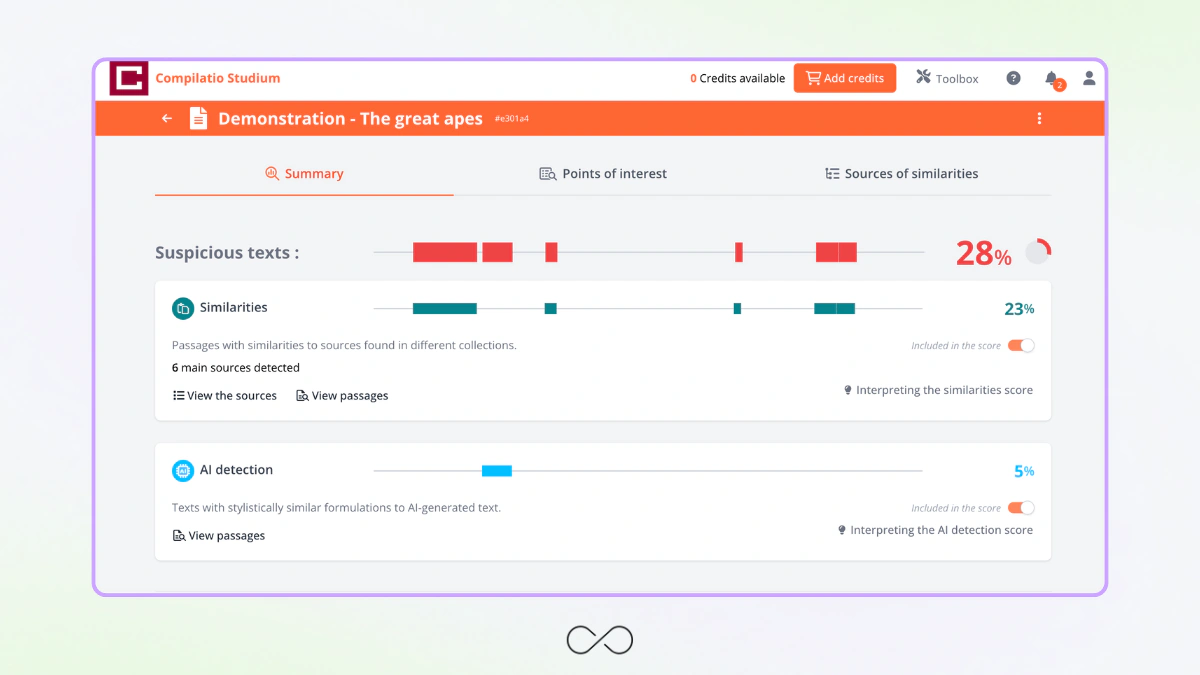
Compilatio is the dominant plagiarism checker online for French-speaking European academic institutions. If you're not in that context, it probably isn't relevant to you. It supports self-plagiarism checking, catching cases where you reuse your own prior published research without proper citation, which is a real issue in academic publishing, and includes features built around maintaining academic integrity in institutional settings.
No free version or free account was available for testing. It uses a credit-based pricing model starting around €4.99 for 5,000 words, purpose-built for institutional academic work rather than content creators.
| Pros | Cons |
| Strong in French and European academic contexts | Limited relevance outside its geographic context |
| Self-plagiarism checking supported | Less practical for content creators or marketers |
| Academic integrity education built in |
Pricing: Credit-based, from ~€4.99 per 5,000 words.
Best for: Students and academics in French-speaking European institutions.
Which Plagiarism Checker Should You Use? (Decision Guide)
If you're a blogger, freelance writer, or content creator: Use GPTinf. The free account covers shorter pieces with free attempts; the paid plan removes the words-per-month cap and includes the humanizer for AI-assisted drafts. It returned the most comprehensive results in testing and is the best free plagiarism checker for writers who use AI tools.
If you use AI tools in your writing: Use GPTinf if you want plagiarism checking and writing quality in one platform, or Copyleaks if you specifically want an AI plagiarism checker with rigorous independent detection. Both address the dual problem. Nothing else on this list does.
If you're a student without Turnitin access: Use Scribbr for high-stakes submissions — it uses iThenticate and returns the most accurate results of any individual-access tool, with detailed reports that show exactly where plagiarism issues are concentrated. For everyday checks where budget is tight, GPTinf's free account works for checking sections.
If you need to check a dissertation or academic thesis: Scribbr. The accuracy justifies the cost for something you've spent months on, and its coverage of academic journals and published research is the best outside Turnitin.
If you're an educator or content team: Copyleaks at the institutional level, or GPTinf's paid plan for teams where AI-assisted content is common. PrePostSEO if budget is the primary driver and you need to check your writing at volume.
If you publish web content and want to check for scraping: Copyscape. It's purpose-built for detecting online plagiarism across billions of web pages, and nothing else does it as well.
If budget is your main concern and you need free attempts right now: GPTinf's free account (500 words/scan, registration required) or Quetext's free version. Both work for short content. GPTinf has the edge if you have any AI-assisted text to check.
What Does a Plagiarism Percentage Actually Mean?
The most common thing that happens when someone uses a plagiarism checker for the first time: they see a 20% similarity score and panic. A plagiarism percentage tells you what share of your text matches something in the database. It does not tell you whether you've done anything wrong. Those are completely different things.
Our test illustrated this clearly: the same passage returned plagiarism percentages from 7% to 100% depending on the tool. The writing didn't change. The database and matching algorithm did. This is why comparing scores across popular plagiarism checkers is meaningless: a 7% on DupliChecker tells you something completely different from a 7% on Copyleaks.
Quotations you've properly attributed will always show up. In-text citations match database sources by design. Common academic phrases, standard terminology, and widely-used definitions will all register as matches. What actually matters is where the matches land. Open the detailed reports. Look at what's highlighted and where the matches originate. If the flagged content is your reference list and standard phrasing, you're fine. If it's core argument paragraphs matching a source you haven't cited, that's a plagiarism issue worth addressing.
Most academic institutions consider below 15–20% acceptable, but there's no universal threshold. The plagiarism percentage is a starting point, not a verdict. When in doubt, check the highlighted sections and ask yourself honestly whether you've cited what needs citing, which is where citation support features on some tools can help.
Can AI-Generated Content Be Detected as Plagiarism?
Plagiarism detection and AI detection are different problems. An online plagiarism checker looks for matches between your text and existing content in a database. An AI plagiarism checker looks for statistical patterns that suggest machine generation: sentence structures, vocabulary distributions, and stylistic tendencies that generative AI tends to produce.
Most traditional detection tools don't do AI detection at all. This was confirmed in our test: the same AI-generated passage returned a "Significant plagiarism" flag on Grammarly's plagiarism checker with no AI callout, 25% on PrePostSEO with no AI callout, and 7% on DupliChecker with no AI callout. Copyleaks was the only tool to independently flag 100% AI Content alongside its plagiarism results, making it the standout AI plagiarism checker in this comparison.
If you run AI-generated text through Scribbr or Copyscape, they might come back clean, not because the content is original, but because generative AI output often isn't literally copied from anywhere. It's statistically derived from training data. The tools that address both layers (Copyleaks and GPTinf) run plagiarism detection alongside AI detection. Running only a standard plagiarism checker on AI-assisted content gives you an incomplete picture.
Free vs. Paid Plagiarism Checkers: When Is It Worth Upgrading?
Free and paid tools both have their place. A free version or free account is genuinely fine for: quick spot-checks before hitting publish, short-form content within the words-per-month limit, occasional use where deep accuracy isn't critical, and getting a rough sense of potential plagiarism before deciding whether a deeper check is warranted.
Free attempts fall short when: you're submitting something high-stakes, you're working at volume and need to check your writing regularly, you need an AI plagiarism checker alongside traditional detection, or you need detailed reports you can export and share.
My test also revealed a meaningful free-tier quality gap: Grammarly's plagiarism checker detects potential plagiarism on the free version but shows nothing useful. Copyscape lists sources but gives no plagiarism percentage. DupliChecker dramatically under-detects. For writers who need real information from their online plagiarism checker (not just an alert) GPTinf's free account and Quetext's free version are the strongest free starting points.
The things worth paying for: unlimited scans with no words-per-month cap, academic journal and published research database coverage, AI detection as an included feature, citation support to fix flagged passages, and detailed reports you can share with a client, professor, or team.
The Bottom Line
In 2026, originality is a more complex thing to verify than it used to be. The old question "Did you copy someone's words?" sits alongside newer ones: does this content contain forms of plagiarism I haven't accounted for, does it overlap with published research I paraphrased without citing, and does it read as genuinely mine?
Our hands-on test put the differences between popular plagiarism checkers in stark relief. The same AI-assisted passage produced plagiarism percentages from 7% to 100% depending on which tool processed it. DupliChecker missed almost everything. Grammarly's plagiarism checker detected potential plagiarism but told you nothing without paying. GPTinf surfaced 152 sources at sentence-level granularity on the free account. Copyleaks was the only tool to simultaneously flag both plagiarism and generative AI content.
For academic work, Scribbr's accurate results and Turnitin's database depth are the standard to match for maintaining academic integrity. For everyone else (like writers, creators, professionals using AI tools) GPTinf addresses both sides of the modern originality problem in one online plagiarism checker.
If you want to start with a free check right now, GPTinf's free account is available after a quick signup — 500 words per scan with free attempts, no credit card required. For regular use, the paid plan removes the words-per-month cap and unlocks unlimited checks plus the full humanizer for refining AI-assisted drafts.
Frequently Asked Questions
What is the best website to check for plagiarism?
It depends on what you're checking. To find the best plagiarism checker for academic writing, Scribbr is the most accurate individual tool as it uses iThenticate and returns the highest accuracy in independent testing. To find the best free plagiarism checker for writers or anyone working with AI-assisted content, GPTinf covers both detection and writing quality in one place, and returned the most comprehensive results in testing.
Which plagiarism checker is better than Turnitin?
For individuals who need accurate results, Scribbr is the closest. For AI-assisted content, Copyleaks and GPTinf are stronger because they function as AI plagiarism checkers as well as traditional detection tools. The answer depends on what "better" means in your context: accurate results, AI detection, accessibility, or value.
Which AI is best for plagiarism checkers?
Copyleaks and GPTinf both use advanced AI and have strong AI detection layers built in. In our test, Copyleaks independently flagged 100% AI Content in the same scan as its traditional plagiarism results, the only free tool to do this. If you mean using a generative AI chatbot like ChatGPT to detect plagiarism: that doesn't work. Use a dedicated online plagiarism checker.
Can ChatGPT run a plagiarism check?
No. ChatGPT has no ability to scan text for plagiarism against a database of existing content. It cannot produce accurate results or detailed reports. Don't mistake generative AI for a verification tool, use a dedicated plagiarism detector.
What is an acceptable plagiarism percentage?
Most academic institutions consider below 15–20% acceptable, assuming the flagged content consists of properly cited quotations and standard terminology. Our test also showed why cross-tool comparison of plagiarism percentages is meaningless: the same passage scored 7% on DupliChecker and 100% on GPTinf. What matters is where the potential plagiarism appears. A high plagiarism percentage driven entirely by a reference list is not a plagiarism issue. A low score concentrated in uncited body paragraphs is. Open the detailed reports, look at the highlighted sections, and make a judgment based on what's actually flagged.