

Best BrandWell AI Detector Alternatives
1. GPTinf – Free & Unlimited BrandWell Alternative
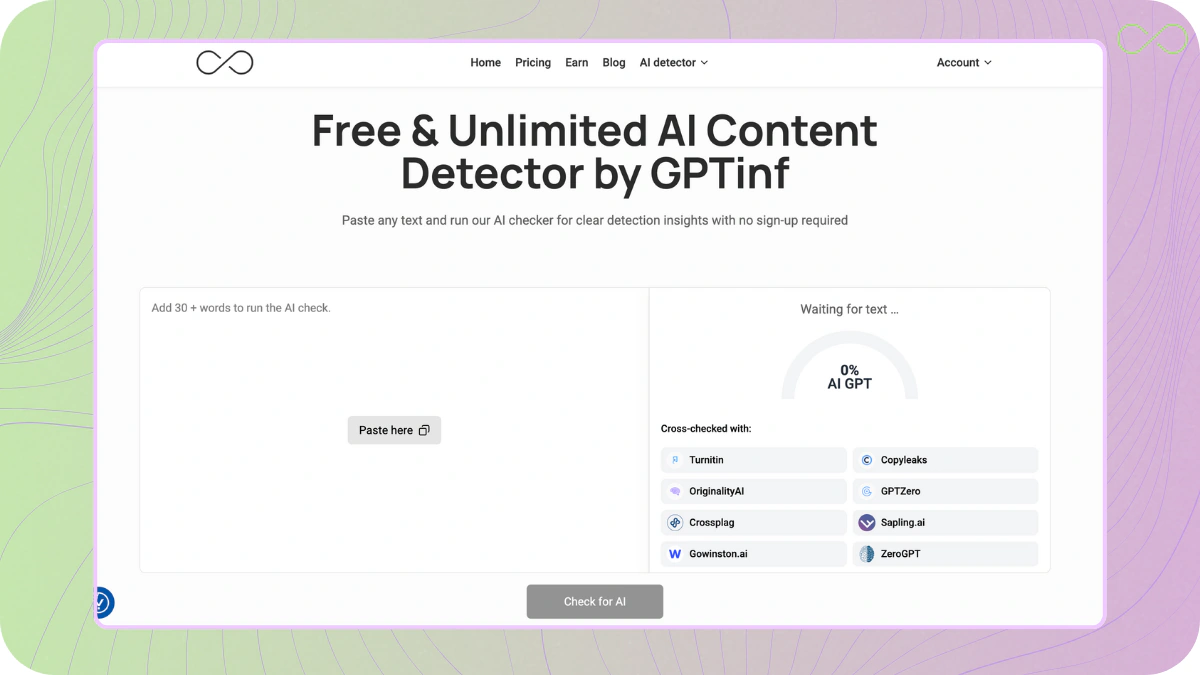
GPTinf Detector is a free AI checker, but it’s not an AI tool. Instead, it’s a robust AI detection system built on a custom codebase that analyzes how your text looks to automated detectors.
What it offers:
- Free usage with unlimited scans and no sign-up
- Detailed AI score for essays, SEO content, and long-form content*
- Focus on reducing false positives rather than claiming magic accuracy
- Clear, practical reports designed for students, teachers, and content teams
*upcoming features
That makes GPTinf a practical BrandWell AI alternative if you primarily want an AI detector instead of an all-in-one content marketing platform.
GPTinf consistently ranks among the top AI content detector tools, and for good reason: its detection approach is transparent, reliable for long-form content, and intentionally designed to minimize false positives. You can also check out the guide that compares GPTinf against other top detectors.
For students, marketer teams, and SEO writers, GPTinf works well as:
- An AI detection step before publishing content for search engines
- A quick check on AI-generated content from ChatGPT or other generative AI
- A way to test revisions before sending work to teachers or clients
| Category | BrandWell (free) | GPTinf Detector (free) |
| Character / word limits | Usually limited for full drafts (often best for shorter checks) | Designed to handle longer text (works better for full drafts) |
| Long-form workflow | Better for quick scans, not end-to-end essay review | Better for essays, reports, and long-form revisions |
| AI detection focus | General AI scoring | Sentence-level feedback* + revision-friendly detection (reduce false positives) |
| Transparency | May offer a single score with limited breakdown | Probabilities + sentence highlights + clearer signals behind the score* |
| Best for | Quick checks, casual content | Students, teachers, freelancers, SEO teams writing at scale |
*upcoming features
2. Sapling – AI Content Writing & Detection
Sapling is a real-time writing assistant with AI content detection built in. It’s aimed at teams handling support emails, sales messages, and business content.
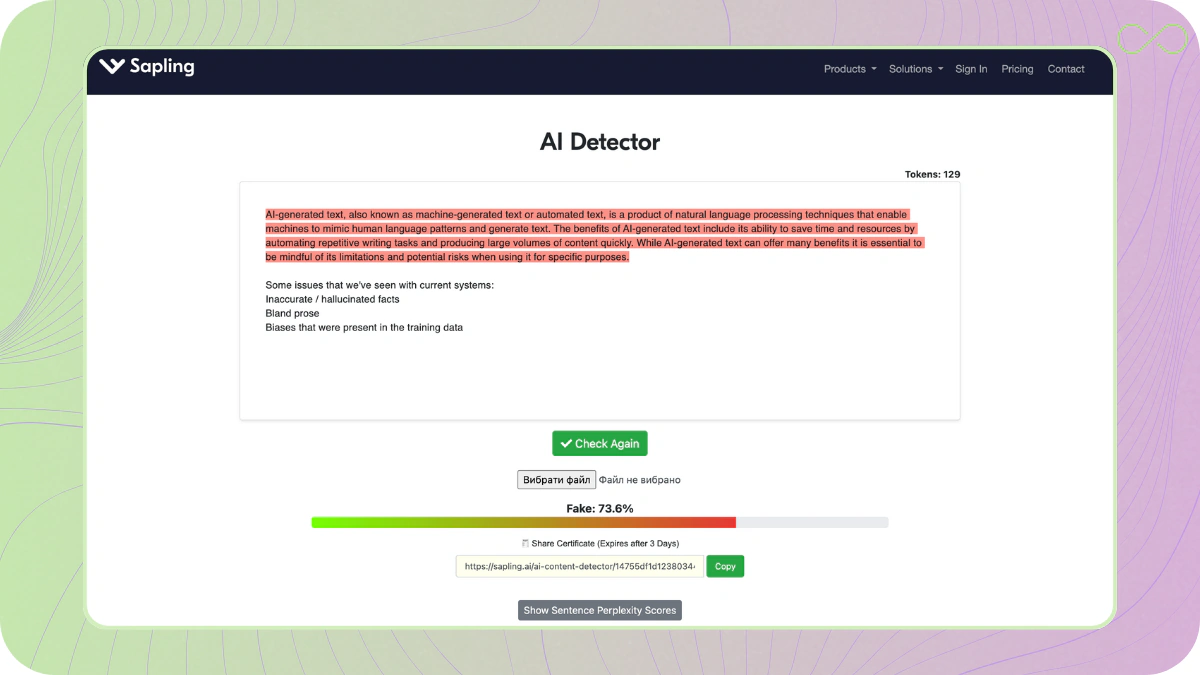
What it offers:
- Real-time sentence-level AI scoring inside your editor
- Grammar and style suggestions alongside AI content flags
- API options if you want to integrate AI content detection into your own tools
Sapling can act as a BrandWell alternative if you care more about AI writing quality and business chat than full content at scale blog generation. It’s useful for:
- Customer-support teams
- B2B marketers
- Teams that want to streamline communication inside one AI tool
3. Originality.ai – Detection Tool for Agencies and Content at Scale
Originality.ai is built for agencies and publishers managing large volumes of content. It combines AI detector features with plagiarism scanning and collaboration.
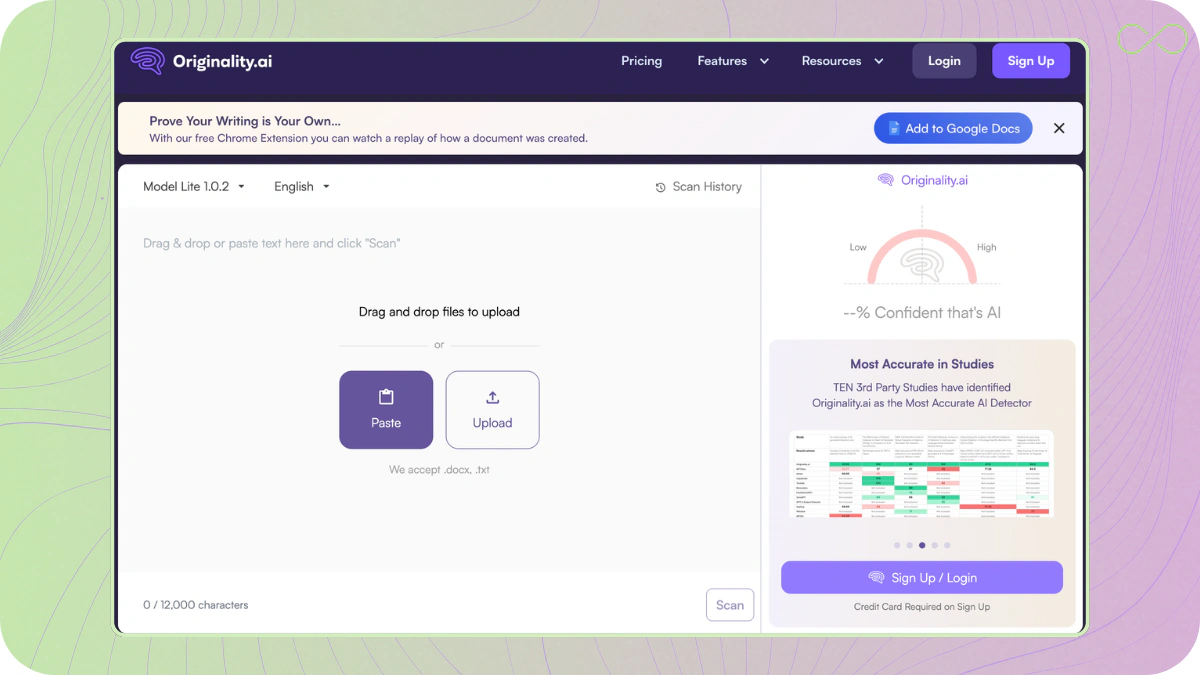
Notable points:
- Workspace features for content creators and editors
- Website scanning to detect AI content across many URLs
- Credit-based pricing instead of a flat free version
This is a viable BrandWell alternative for teams that:
- Already have an AI writing platform or an alternative to ChatGPT
- Need an external detection tool with team control
- Want clearer reporting for audits and AI reviews
4. ZeroGPT – Quick AI Content Checks
ZeroGPT is a free AI detector that people often use as a fast checker for AI writing and ChatGPT-style text. But tests show it can still misclassify text and shouldn’t be used alone.
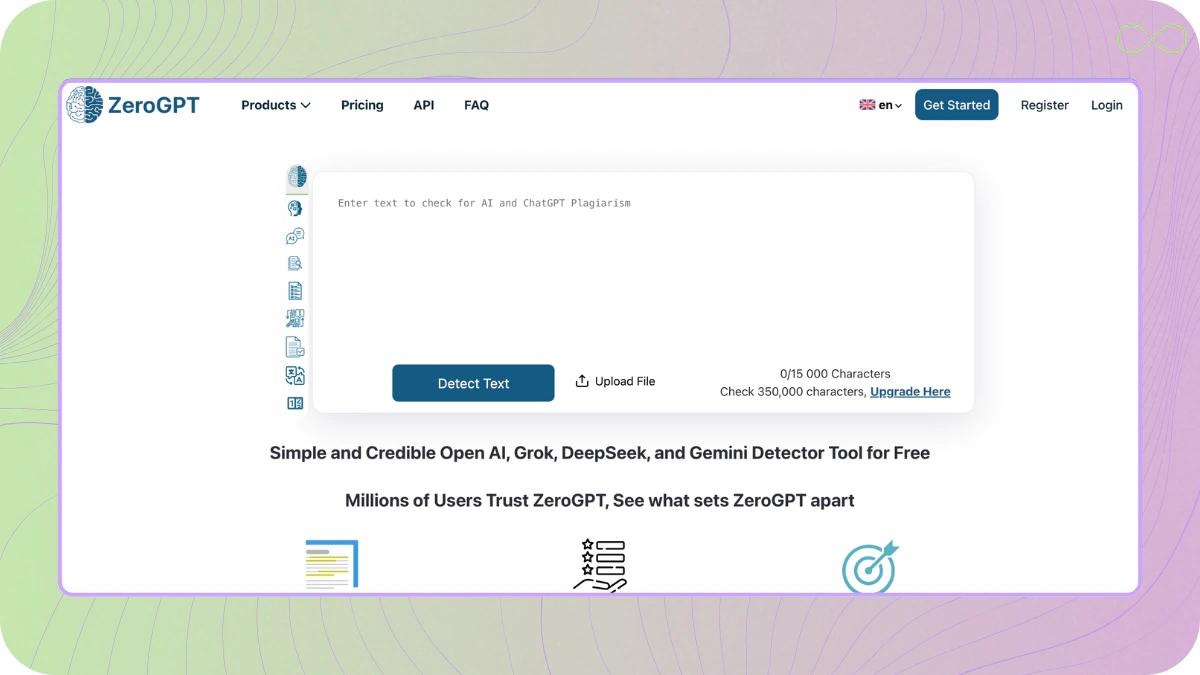
Use cases:
- Quick checks on small snippets of AI-generated content
- Casual validation of content creation experiments
- A second opinion alongside GPTinf or other tools
For long-form content creation and SEO, the character limits and lack of deep reporting make it more of a backup tool than a primary AI detection solution.
What to Look For in an AI Detector (A Handy Buyer’s Guide)
Before you pick any BrandWell alternative, it helps to know what a good AI detector should actually do.
1. Robust AI detection across newer AI models
Most detectors were built for older AI models. Studies show many AI content detection tools are less reliable on GPT-4-style models and can mislabel human work.
That's why it would be best to look for an AI detection tool that:
- Clearly states which AI models it tests against (GPT-4, GPT-5-style, Claude 3.5, Llama 3, etc.)
- Publish method notes instead of only score marketing
2. False positives and fairness
Multiple studies find that generic AI writing detectors can flag real human work, especially from non-native writers, as AI-generated.
For students and freelance content creators, that matters more than a flashy UI. Good AI content detectors:
- Treat results as signals, not verdicts
- Explain which sentences might look AI-written
- Make bias concerns easy to understand
If you want to understand this better, check out GPTinf’s own guide on how AI detectors work and where they fail. It breaks this down in simple language.
3. Long-form and large volumes of content
If you deal with long-form content or large volumes of content, short character caps slow you down.
Ask:
- Can the free version handle full long-form articles or only snippets?
- Is there a realistic free plan or only a short free trial? (BrandWell, for example, keeps the free version at 2,500 characters unless you upgrade.)
4. Reporting, exports, and content strategies
For teachers, agencies, or SEO teams, a good detection tool should help with:
- Simple reports you can share in AI reviews or client reports
- Insights that actually influence content strategies, not just a single number
- Clear feedback you can use to improve content quality and content creation, and optimization
5. Alignment with your workflow
Think about your workflow:
- Do you write in ChatGPT or an alternative to ChatGPT and then paste it into an AI detector?
- Do you write inside an AI writing platform like BrandWell’s generative AI suite?
- Do you need an AI agent or an AI writing assistant built into the editor, or do you prefer a separate, neutral checker?
For many users, it’s cleaner to keep AI writing tools and AI content detection separate: one for content generation, one for checking.
How to Choose the Right Alternative for Your Needs
Here’s a simple way to match BrandWell alternatives to your situation:
Students and teachers
- Pick GPTinf Detector as your main AI detector. It’s tuned for essays, has no scan limit, and supports ethical use policies.
- Use GPTinf’s guides on avoiding AI detection in writing to improve your own style instead of leaning on one-click rewrites.
SEO and content marketing teams
- Combine an AI writing tool (ChatGPT, BrandWell, or another AI writing platform) with GPTinf’s checker
- Use a separate AI detector for content creation and SEO optimization rather than relying solely on a single platform’s internal scores.
Agencies handling content at scale
- Consider running GPTinf as a fast, user-friendly check, then use Originality.ai or similar tools for full-site audits and documentation.
- Treat AI detection as part of a broader quality process, not your only safety net.
Marketer needing an all-in-one content marketing platform
- If you like BrandWell’s content intelligence suite, keyword tools, and brand growth features, keep using it as your AI writing platform.
- Still, it’s smart to run high-risk pieces through an external detector like GPTinf to balance BrandWell review scores with a second signal.
Final Thoughts
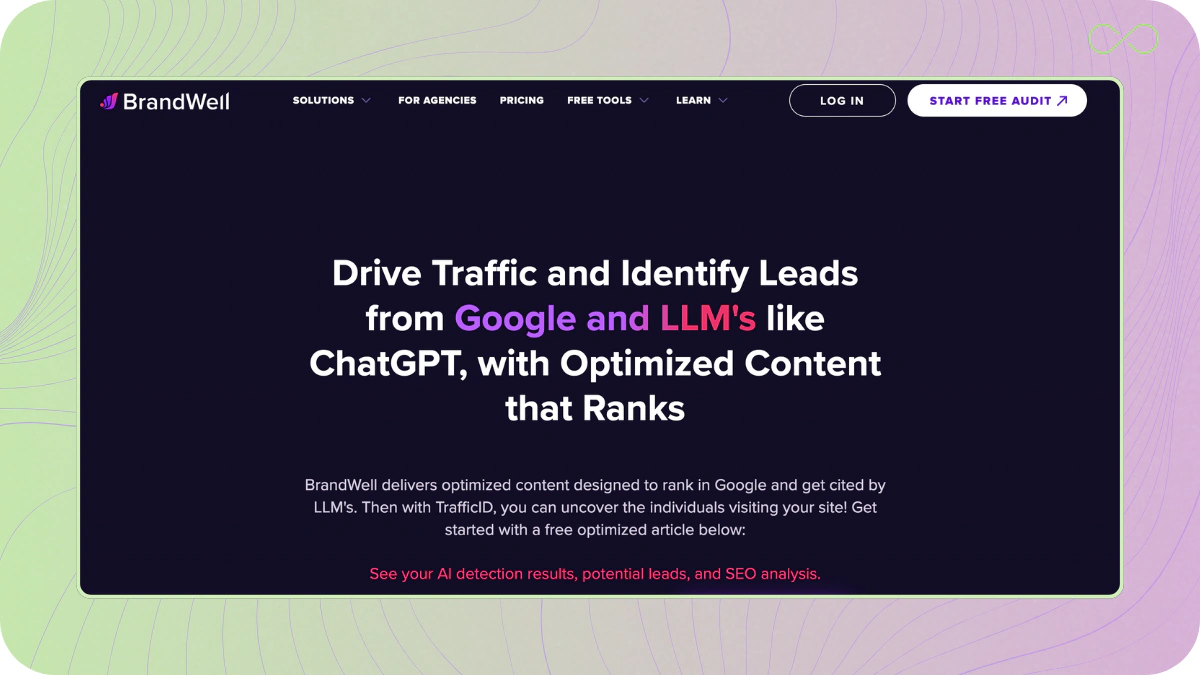
BrandWell’s AI content detector is a useful tool if you already use its all-in-one content marketing features and want quick AI checks. But its free version caps scans at 2,500–3,000 characters, and serious research shows that AI detection in general has reliability limits and bias risks.
If you want a BrandWell AI alternative that:
- Stays focused on AI detection
- Helps you see how detectors might misread your writing
- Supports ethical use and academic integrity
- Acts as a free alternative without paywalls
…then GPTinf Detector is the most straightforward fit. It doesn’t promise magic or undetectable text. Instead, it gives you transparent feedback so you can refine your own writing, build safer content strategies, and feel more confident each time you hit “submit” or “publish.”
FAQs
1. Is BrandWell’s AI detector reliable for long-form or academic content?
BrandWell works well for short checks, but its free version has a ~2,500-character limit. For long essays, research papers, or SEO content, its accuracy becomes inconsistent, and the short cap forces you to check sections separately.
2. What’s the best free alternative to BrandWell for AI detection?
GPTinf is widely considered the strongest free alternative because it offers unlimited scans, focuses on reducing false positives, and works better with long-form content. It’s also frequently listed among the top AI content detection tools due to its transparent scoring.
3. Why do AI detectors flag human-written text as AI?
Most detectors analyze patterns, sentence structure, and statistical “AI-like” writing characteristics. Human writers — especially non-native speakers or those using simpler structures — can accidentally match those patterns. That’s why using tools that emphasize fairness and reduce false positives (like GPTinf) is important.
4. Can I use BrandWell and another detector together?
Yes. Many users run fast checks inside BrandWell but use an external detector like GPTinf or Originality.ai for confirmation — especially for high-stakes writing. Using more than one detector yields multiple signals rather than relying on a single tool.
5. Do AI detectors work on text generated by newer models like GPT-4, GPT-5-style models, or Claude 3.5?
Not all detectors keep up with newer models. Some were built for older GPT-3-style text and misread advanced writing. When choosing a BrandWell alternative, look for detectors that explicitly test against modern models and publish method notes. GPTinf is one option that regularly updates its detection approach to keep up with newer AI systems.